Tuesday, March 08, 2016

An open letter to some Bangladeshi fans..

Before I address some Bangladeshi fans, here's something I want to say to all Bangladeshi fans - Congratulations! You are no longer the 'so-called' minnows of World Cricket. You have proved beyond doubt that you belong to the big league - definitely in the T20s and ODIs. For all the passion you have shown by supporting your team, you guys deserve every single moment of the success coming your way. Yes, there are challenges that lie ahead, even bigger ones that your team probably haven't been through. But I am sure your team, with your passionate support, will overcome them just the way they did till now. My congratulations again. Maintain your level of passion and see your team take on the biggies of this sport with confidence and hunger to win.

Now, to those few handful of Bangladeshi fans - 

Grow up!

Seriously.

It's one thing to show and exuberate passion for your team. It becomes crass and downright ugly when you cross all limits of sportsmanship. What some of you did creating and sharing the picture of a Bangladeshi player holding the head of MS Dhoni, Indian captain, was appalling to say the least. If you haven't seen that image, search Google for "Dhoni Taskin image". 

Now that the final is done with and Bangladesh lost to a dominating Indian team, I think and I hope, you guys have got a stunning response from MS Dhoni they way only he can respond. He could've negatively commented on it, abhorred it, raised a complaint etc. But he chose to respond on the pitch. And boy, was that some response?

MS Dhoni en route to winning the Asia T20 cup 2016

I know that every fan-base has a set of people who spoil the image by crossing the limits of sportsmanship. It happens in every sport. It happens for every team. Bangladesh has a Cricket team that's on-the-up. They are the team that can genuinely pose a threat to the best in the world and probably win it too. They are no longer the minnows who gets defeated by the big guys and who take their share of the revenue and leave the event without a trace. By performing the way they are doing right now, they can stake claim to the biggest share of the spoils.

I can understand the passionate surge you guys are having when your team defeats some of the traditional biggies of the game and reaches the final of a big T20 tournament. We have all been through it. Defeating the all-conquering West Indies in the 1983 World Cup final was India's moment. We were on the world map in cricketing terms. And then there was no looking back. Yes, there were set-backs in between but these things happen. We have had our shares of mistakes too like the 1996 semi-finals against Sri Lanka where some of the fans threw stones / projectiles on the field to stop the game and eventually hand over the match to Sri Lanka. There are many more such instances. We have learnt the lesson the tough way. You are our younger neighbours. Take this as a word of advice - don't repeat the mistakes the rest of the teams did. Don't bring the sport to disrepute. It's not worth it and you will regret this your whole lifetime. You guys are great fans supporting a soon-to-be-great team. Don't spoil it.

As fans, the best you can do right now is to support the team and accept the results coming your way. It's a sport after all. Treat it like one.

Let's move on.

Saturday, March 05, 2016

When Dilshan had an Isaac Newton moment!

Cricket can be funny sometimes. Especially when you least imagine it. Not to mention if the game is evenly balanced and anything can happen anytime. How's this for funny incidents - 
  • Outfield player attempting to field the ball for a single run, the ball passes between his legs and goes for a boundary - Funny
  • Fielder diving to field the ball and his shorts betray him - crass but funny
  • Certain batsman's fixation with a run-out (either him or his team-mate) - Funny
  • Batsman attempting a shot but the ball finds its way towards the pelvic region - extremely painful but funny
  • West Indies players celebrating a wicket by dancing - funny and entertaining
  • Lance Klusener and Allan Donald messing up while attempting to complete the winning run against Australia in a World Cup semi-final match - funny, only if you are an Australian!

Assume the whole cricketing world is watching a game you are part of and you somehow make a complete 'fool' (for lack of a better family word) of yourself. It may not have an impact on the game as the ones mentioned above but will be totally worth it. That's what happened years ago with a Sri Lankan player.


Dilshan hit by ball on top of head
Massaging the embarrassment
OK, lets just start getting things in perspective here. The bowler bowled the delivery. The batsman swung wildly at the ball and missed it. This incident itself is funny if we think from a batsman's angle - poor footwork and just a wild swing. But that's not what we are talking about in this clip. The wicket-keeper took what he thought was a catch and started celebrating without the umpire even declaring the verdict. Some can find this funny too. But still that's not what we are talking about. What happened afterwards made the whole incident a laugh riot! He threw the ball in the air (typical way of celebrating a wicket) and then the ball came down towards its rightful owner. Talk about taking things head on!

I have always failed to understand why fielders celebrate by throwing the ball in the air. Imagine batsmen throwing the bat in the air when they score a century? If you want to celebrate, run towards the bowler or a nearby fielder, hi-five them, even do chest thumping the way Lee-Hesh used to do! If you get the wicket of a dangerous opposition batsman, dance around and have fun. The sound systems across most stadiums are top-notch now and they play loud music when a wicket falls. Dance when the music starts. One can do all these 'harmless' acts and can even invent a new way to celebrate like some footballers do. If you are not the creative kind, then simply pass the ball to the umpire - which is what they are supposed to do anyways after a wicket! There is absolutely no reason to throw the ball in the air unless you want to prove to your team-mates that your throw reaches the heights.

Don't get me wrong. I used to celebrate this way all the time. Whenever I took a catch, I used to throw the ball in the air, but, unlike other players, I used to catch the ball again. Maybe I was scared of the same incident that Dilshan went through or maybe I needed to show everyone that my catch wasn't a fluke. But then, don't take my word for it. I have not even represented my university in a game of Cricket - just my housing society, class, school and college. 

Dear cricketers, please find a better way to celebrate a wicket. The world has moved ahead, its time you do the same with your celebration.

PS: If I happen to play Cricket again and manage to catch a ball to trigger a wicket falling, I will still celebrate the same way. Guess, some things won't change.

Saturday, December 05, 2015

How can ICC replace coin-toss in Cricket?

Cricket is undergoing a change, and hopefully a positive one. Changes in rules (free hit rule), changes in the instruments (pink ball), changes in format (plan to have 4 day test matches), management changes (India, Australia and England now holding the reins) among others. While it's debatable that all are positive changes, but we can take solace from the fact that there are changes after all. Someone is trying hard to ensure their objectives (of making Cricket global) are met. Be that as it may, there are still some rules / events that need to change or be dropped completely. And it all depends on what the audiences want. Let me take the liberty to generalize what audience, especially the newer lot, might want from the game of Cricket.

What new audience would like to see?
  • Competition as opposed to one-sided matches
  • Concise format games introduced in new countries (T20 and ODI)
  • Making Test cricket (the ultimate challenge for any cricketer) more interesting and exciting

There are many ways in which all / some of the above mentioned requirements can be achieved. And it's a larger topic. We will discuss this, but maybe at an appropriate time.


In this post, lets concentrate on making the game of Cricket more interesting by completely eliminating an event of "luck" which happens before the game begins - "coin-toss". For the uninitiated, "coin-toss" is an event that gives a team an opportunity to decide what it wants to do when the game starts. There are two options the toss-winning team can decide - batting and bowling. 

Personally, I am not a big fan of coin-toss as it inadvertently favors one team over the other. This event is umpteen times more significant than a coin-toss in Soccer or any other sport. Here, the team that wins the toss can shift the balance of the game even before a single ball has been bowled. That's how significant it is in the game of cricket. So, by all means, coin-toss should be scrapped from Cricket once and for all. 

But how do we decide who gets to make a decision? I think there are two ways in which we can do that - 
  1. The most popular choice - the visiting team gets to decide. Simple, isn't it? The home side anyway has the home advantage, so to make the scale more balanced, the visiting team gets to choose. This is the easiest way in which we can implement and seems fair to everyone. But there are some loopholes here. Firstly, what if the game is being played in a neutral venue like the recently announced India-Pakistan series to be played in Sri Lanka? Who gets to decide then? Secondly, what if a bottom-ranked team hosts a top ranked team? Here the top ranked team, since they are visitors, gets to decide who bats first? Isn't this significant disadvantage to the bottom ranked team? Despite the home conditions, the bottom ranked team are not expected to win. Not having the option of a coin-toss will also eliminate whatever luck that could have come their way! Another point being raised in support of this choice is that it will prevent home team to 'tweak' the pitch to favor their strengths. I disagree. On the contrary, tweaking of pitches will increase! With the 'rub of the green' going the visiting teams way, the home team has little option but to ensure the pitch behaves the way they want. In my opinion, this option is popular but not foolproof.
  2. My Choice - the lower ranked team to decide - This is what I feel should happen. Let me explain. First of all, it overcomes all the disadvantages of previous option. Lower ranked teams will have an additional ammunition to fight a 'stronger' opponent. The higher ranked team will still have to remain strong to win. That's pretty straight-forward. Now let's include the home conditions. If a lower ranked team plays at home, this team will have additional advantage to make the best use of the conditions by choosing to bat / bowl. The top ranked team should be strong enough to cope with alien conditions. Take Australia v/s Zimbabwe for instance. If Zimbabwe are playing at home, they get the added advantage to decide who bats first. Although it may still not change the prediction of the result, Zimbabwe now have an added option to play to their strengths. In the first option, the onus lies with Australia who honestly won't need it. This is probably an extreme case. Take Australia and India for example and you will see this option will make more sense.
Anyone remembers the computer game 'Need For Speed 2'. It has an option called "catchup" which allows the lower placed racer an opportunity to come close to its closest competitor and thereby make it more competitive. Although it was just in a video game, there's no harm to implement the same in real life. Cricket is no different. There's no harm in giving an extra something 'legit' that can aid the lower ranked opponent. This also ensures the top ranked team remains consistent (and not complacent) throughout the game thereby raising the quality.

What do you think?

Thursday, December 03, 2015

India-Pakistan bilateral series controversy

Any Cricketing decision made in India will attract controversy. And I mean ANY decision! Even Anushka's presence in the stadium when Virat Kohli was woefully out of form became a controversy. Shahrukh Khan messing with the cops at Wankhede stadium (Mumbai) became an IPL controversy. We are good at it, aren't we? We link anything to everything we see in front of us. Maybe we misunderstood the "connecting the dots" concept. Anyone remotely linked to Cricket inadvertently drags Cricket into the mess around them. Or if they don't do, the media surely obliges. Why? Because it sells.

Either ways, we now have another controversy to deal with. I won't say its needless but its too sensitive and any decision favouring one party will hurt the other. The controversy is the resumption of India-Pakistan bilateral series. There are largely two big factions with strong views. One faction want the series to be scrapped and the other sees no problem in resumption of this series. Following are some of their views and what I think about it.

This is what the people who don't want an India-Pakistan bilateral series are saying - 
  1. How can you play against a country that has brought terror on your own country?
    My Take: This is a highly debatable topic and I personally don't have a clear stand on it. First of all, blaming a country in general is not entirely correct. There are organizations in the country that are terror oriented. Also, they themselves are victims of terror within their own country. Even schools are not spared. Having said that, it's not a justification of what happened in India in the past. Given this background, should we play cricket? I don't know. I will, however, take a stand (not clear, again) and say it's not the right time to play bilateral series, even on a neutral venue. Our soldiers and our people who were victims of terror deserve a closure and this series is by no means helping the cause.
  2. This is no friendly gesture. This is simply a money-making series.
    My Take: Obviously it is. Let us not be naive in thinking this will bring brotherly relations between two countries. Cricket is a sport and, like in all sports, there will be competition. Competition is always intense between arch-rivals. Indian and Pakistani players won't give even an inch on the field. Same goes with the fans of the respective teams during the match. So, the idea of "increasing" brotherly relation goes out of the window. Relation among fans have generally been warm and receptive. And that should / will never change. But this will be primarily a series that will make lots of money for the respective cricket boards, marketers will rake in more money from more sales, new cricket stars will be formed, memories will be etched (we still remember Sreesanth taking the catch to dismiss Misbah and help us win the inaugural T20 World cup in 2007, don't we?). Let's be honest here. Its serious business and all about the money. Let's call a spade, a spade.
2007 T20 World Cup Final India Pakistan Misbah Sreesanth


This is what the people who want an India-Pakistan bilateral series are saying - 
  1. Cricket will help accelerate peace talks between two countries.
    My Take: I don't think so. It's like saying, the pain in your leg will go if you massage your hands! Yes, I agree, Cricket is a virtual religion in India and Pakistan. But the issue at hand is far bigger and more grave. This may / may not work. Let's not over-complicate things here. Cricket is a sport. At max, it will allow key personnel from both countries to come together for a photo-op. Nothing more, nothing less. Remember, the photo ops that happened when India played Pakistan during the 2011 World Cup? Lets not make Cricket something it clearly isn't.
  2. What Cricket has to do with politics?
    My Take: In an ideal world, Cricket has nothing to do with politics and government between the two countries. But this is not an ideal world we live in, right? So, whether we like it or not, Cricket will forever be linked with politics and the government of the day. There's no shying away from it. Ironically, India's foreign policy is also connected to the relations we have with Pakistan. Cricket simply adds more masala to it.

And this is what the rest of the folks feel - 
  1. Don't care. My take: Who's to argue?

Honestly, we have a lot of issues within our country to fight for. Playing Cricket with Pakistan should be least of our worries. In a way, it's good that the series will be held at a neutral venue. Local fans don't have to pay for tickets and can watch it at home, thus saving hard earned money. Neutral venue fans will be able to witness high level of competition. Country hosting the series will rake in more money than what they do when their own team plays (marketing magic). And people within India who doesn't want this series can chose not to watch it at all. Win-win situation for everyone right? Wrong. I am sure our media will still find controversies in this issue and we will quickly lap it up. 

That's the way it goes.

Saturday, November 14, 2015

How IPL is planning to pick two teams for two years?

And, as we speak, IPL is back in the news!
View through glasses IPL current state vs IPL to be state
Transparency is what IPL will be focussing on
Enough of all the recent news bits like Bihar elections, Beef ban, award-wapasi, it's time for some CEC (Cricket, Entertainment and Controversy). You simply can't keep IPL out of mainstream news, can you? Amidst all the brouhaha, IPL was quietly cleaning up the mess that was self-created. It was quiet since cleaning up is not part of the agenda of mainstream news. Heads turned in the BCCI fold due to the new governance structure put in place. Roger Binny stepped down because his presence can jeopardize (or improve, whichever way you look at it) the career of his son Stuart Binny. Anil Kumble stepped down as he is still part of Mumbai Indians franchisee. Saurav Ganguly took his place. 

But what about the two banned teams - CSK and RR? And their players?

BCCI are adamant to have an eight team IPL for the next two years since their original IPL concept proposal was budgeted based on at least 8 teams. Lesser number of teams will mean less revenue in BCCI coffers and ever lesser amount as revenue for IPL teams. As a solution, they decided to replace 2 banned teams with two new teams, a eureka moment (sic) indeed.

So, how will the two new teams be finalized? Reverse auction process. The base price for both teams is set at Rs. 40 Crore. The entities bidding for teams will have to bid lower than 40 crore and the two least bidders will be selected. As per Rajeev Shukla, IPL chairman, "It will be a walk in bid on December 8. The base price for reverse bid from central revenue pool is Rs 40 crore and the party which bids for lowest share from central revenue pool will be the winner of new team". Surprised? No, BCCI is not in a generous mood. The bidding is not the amount the winners will pay BCCI, instead it's the amount BCCI will pay the two winning bidders from the central revenue pool. Interested parties will have to bid as low as possible - mathematically even a negative amount. A negative amount would mean the winning bidder will pay the BCCI the bidding amount for two years.

How long will these teams remain? Two years. That is as per the current scenario. Post two years, IPL will complete 10 years. If you remember, the original contract with all IPL franchisees was for 10 years post which all players will again be in the auction pool. IPL, in a way, will restart again. CSK and RR will come back in the fold after the two year ban.

Why will anyone bid for a team for only two years? It seems illogical in terms of business. To break-even, an IPL team needs a minimum of 4-5 years (RR was an exception). In IPL, you invest heavily in the beginning and reap the rewards in the long term. BCCI is aware of it and hence the concept of reverse auction has been introduced. Also, bidders will know that the platform provided by IPL is on a global stage. Winning the bid to have a team in IPL will translate into a huge marketing platform that will fast-track the brand for years to come, if handled properly. The players of the team automatically qualifies as brand promoters. Huge investment, potential loss in short term but a huge opportunity in the long term. The only constraint is the need for funds to invest for two years. Another reason could be the flexibility the IPL rules provide (sarcasm, indeed). IPL-11 may have more than 8 teams, if the return on investment is significant with minor tweaks in the format.

What about players of CSK and RR? Ten players, 5 from each side, will be drafted into these two new teams. The rest of the players will be auctioned. One concern the owners of two teams will have is that they have a lesser population to choose from. What if the new team wants Ajinkya Rahane or Chris Gayle? What if they want to buy a player from Delhi / Mumbai? IPL has an option to buy and sell players between teams outside of auction. This option, I believe, should be applicable to new teams. The only catch is the team who currently owns the player should be interested to sell.

Will Kochi and Pune be involved? No. And no reason has been provided for this decision. This is the masala the mainstream news may focus on.

Well, that's about it. December 8th is the date for the bidding process. Unless there's a twist in the tale. Don't hold thy breath!

Monday, October 26, 2015

The Nawab of Najafgarh steps down

Any sport has to have some basics and some instincts that go along with the basics of the game. And these are unique for a particular game. Batting in Cricket needs different set of technique than batting in Baseball. Skills needed in Tennis is different from those needed in Badminton. Hockey on an artificial green turf is different from Ice Hockey, although the skill set is fairly the same. Even within a game, different players have different style and they are all effective. But you still need the basic technique upon which you will inculcate your own style of play. 

Take Batting in Cricket for instance. Sachin Tendulkar and Rahul Dravid are legends of the game. They have both been successful in their game. Yet they have different styles. Sachin Tendulkar is relatively more charismatic while batting and is a treat to watch when in full flow. Rahul Dravid relies relatively more on technique and is a live example of how to bat in a manner desired of a batsman. You may have a different perspective, but I believe both these legends are at the same level in terms of success. One is not greater than the other. However, I am sure you will agree with me when I say both these players had their roots in technique and developed a niche for themselves. 

Every once in a while comes a player who deviates from the routine and relies completely on a different set of skills and still succeeds. A player who has his own basics to follow, his own techniques yet highly effective. Indian Cricket had one such player. And his batting was like eye-candy especially for those who are more goal-oriented than the journey one takes to achieve the goal.

I am talking about none other than Virender Sehwag. 

Virender Sehwag retires from Cricket #ThankYouViru

He completely defied the most basic tenet of batting - footwork! Instead, he trusted his eye, his hand and his confidence on the pitch. And he succeeded. He made a name for himself even when Indian Cricket had other batting stalwarts who were breaking records with ease. It's easy to be a top player when you are surrounded by average ones, but Sehwag made it count when he was playing with Sachin, Saurav, Rahul and VVS. Sachin had charisma, Saurav flamboyant, Rahul with his rock-solid technique and VVS with style. Among them came Sehwag who simply went after the bowling with little to no respect for the bowlers (on the pitch, that is).

I have seen the best of Indian cricket play together - Sachin Tendulkar, Saurav Ganguly, Rahul Dravid, VVS Laxman, Virender Sehwag, Anil Kumble, Zaheer Khan, Javagal Srinath etc. The current crop is exciting, no doubt but they have time to attain legendary status in Indian Cricket. With Sehwag retiring, that 2000's era is now well and truly over.

If you want to bat the "Virender Sehwag" way, mug up the following steps - 
  • Completely trust you hand-eye co-ordination
  • Do NOT look at the scorecard. Scoreboards contain some numbers pertaining to the game. There are other team members who will do the math
  • Let your instincts talk on the pitch
  • That's it! No kidding, that's seriously how simple it is to learn about Sehwag. The only challenge is to effectively utilize them on the pitch.
Virender Sehwag started by being a Sachin Tendulkar look-alike, then a batsman who has similar batting  effectiveness of Sachin Tendulkar but ended being the original Sehwag! Thank you for the wonderful memories Viru-paaji. Your triple centuries was amazing to watch, so were your double century and innumerable centuries in ODIs. The way you went after bowling especially during pressure situations made you unique in this group of Indian Cricketing legends. 

The Nawab of Najafgarh has stepped down. All hail the Nawab!

Monday, September 21, 2015

How to describe Cricket to a Baseball fan?

A change of location forces you to change your perspective and more precisely, your choice of words during a discussion. For instance, I was talking to a friend of mine who has spent more than 5 years in the US about how much I love Football. And he was amazed that I was passionate about a game that's primarily played on the American soil. I told him that it's played the world over and hence is known as a global sport. He was unaware that Football was a global sport. This went on for a while till we realized I was actually talking about Soccer and my friend about American Football! For those now in the know, American Football is more like Rugby with helmets.

Another common discussion revolves around an American sport of a different kind known as Baseball and its like-for-like counterpart, Cricket. I found out that a colleague of mine happens to be a Baseball fan. And I am an Indian; that automatically makes me a Cricket fan. Yes, despite the mess that's happening in the administration side of the game, I am still a fan. He wanted to know more about Cricket since he has seen Indians & Europeans play this game during weekends. I was, obviously, interested to know about Baseball. And so we went on exchanging whatever knowledge we had on our respective games. 
Baseball vs Cricket comparison How to explain Cricket to a Baseball fan
This is how I explained Cricket to a Baseball fan - 

  1. Baseball has 4 bases. Cricket has only 2 bases. We call it stumps. I wanted to tell him that these are also called wickets, but that would confuse him more. How can the same work (wickets) be used for an object and an event in the same game? I honestly, have no answer for this.
  2. In Baseball, one batsman (known as batter) starts the game. Cricket has two. Number of batters in Baseball can increase up to 4. In Cricket, it always remains at 2 till 10 wickets go down.
  3. Baseball calls the person who delivers the ball as a pitcher and the person who is stationed behind the batsmen as the catcher. The same are called bowler and wicket-keeper respectively in Cricket.
  4. In Baseball, if the bat hits the ball, the batter has to run towards the next immediate base. In Cricket, the option is provided to the batsmen whether to run or not. The batsman decides according to the situation.
  5. Baseball doesn't allow a batsman to run if the balls ricochets behind him. Cricket provides the batsman with that flexibility.
  6. The maximum runs that can be scored in Baseball is 4 (assuming all 4 bases are occupied). In Cricket, it's 6 (assuming the delivery is legit). 
  7. If the ball crosses the ground boundaries defined without a bounce within the boundary, it's called a "home run". And the runs will depend on the number of bases occupied by the batter. If he was alone, it will result in one run. In Cricket, the batsmen on the ground are always two and run is always six. And, for obvious reason, the event is called a "six". 
  8. All the outfield players in Baseball have gloves on their non-throwing hand. In Cricket, only the wicket-keeper and two batsmen wears gloves.
  9. In Baseball, the running of one batter occupying a base is usually independent of other batter. In Cricket, however, the running is totally dependent and is based on mutual understanding.

Not a bad comparison huh? But as they say - while in Rome, do as Romans do. Or, while in the US, start loving Baseball and American Football. I have already started this process. I am now waiting for my colleague to help me understanding Baseball the way I explained Cricket. Lets see if he's upto the challenge.

Sunday, July 26, 2015

What goes along comes along? Isn’t it IPL / Kochi Tuskers?

Once upon a time, not so long ago in 2011, there were a group of investors who wanted to get involved in a lucrative, high visibility, highly marketable sporting event and went on to bid a mind blowing Rs. 15.33 billion for owning a team. They selected Kochi as their base city and hence the team’s name became “Kochi Tuskers Kerala”, the tusker part derived from Elephants in Kerala. 

Kochi Tuskers Kerala logo comeback in IPL

But this agreement was by no means, a “happily ever after” scenario. Immediately after the deal was won, Kochi Tuskers Management developed internal ownership issues. This was, after all, a franchisee owned by many owners in unequal measure. Only after BCCI gave them a 30 day termination notice, Kochi Tuskers management prepared a revised structure of agreement. This was then agreed by BCCI and Kochi Tuskers were allowed to play in the IPL of 2011. 

Phase 1: Upper Hand – IPL / BCCI.

One year later, Kochi Tuskers were eliminated. BCCI were of the opinion that Kochi Tuskers for breaching its terms of agreement.  The issue was something related to the bank guarantee. The case went to court and the franchisee’s plea not allowing BCCI to encash the bank guarantee was rejected. BCCI gleefully did the needful. Part of the bank guarantee went to fund the salaries of the players who now don’t have a team.

Phase 2: Upper Hand – IPL / BCCI.

And now brace yourself for another twist!

Kochi Tuskers then challenged the withdrawing of bank guarantee in court. The final verdict happened this month (July 2015). Kochi Tuskers won the verdict and the court ordered BCCI to pay up the bank guarantee with interest! The amount comes to around Rs. 550/- Crore (other sources have calculated the amount to be closer to Rs. 900/- Crore). If the BCCI doesn’t pay up, the amount will increase by 18% annually. This has come as a big shock for BCCI who are already feeling the pressure of playing the next edition of IPL with 6 legit teams after Chennai and Rajasthan were suspended by Justice Lodha committee.

Phase 3: Upper Hand – Kochi Tuskers Kerala.

There’s one way BCCI can reduce the pressure significantly. BCCI needs 2 teams to replace / substitute for Chennai and Rajasthan so as to play IPL-9. Broadcasters and advertisers won’t allow IPL-9 to start or will negotiate for a reduced telecast / spot rates which BCCI won’t allow. Now, the twist is Kochi Tuskers have expressed interest to come back to IPL and are ready for BCCI to adjust the penalty amount from the annual franchisee fee. BCCI are left with no other option but to concede to Kochi’s request. I don’t think BCCI will take this up legally since with every passing day, the penalty amount is reaching unpayable proportions. The only option left is an out-of-court settlement which is where Kochi can make a grand comeback!

Life has come a full circle for Kochi Franchisee. But, in all fairness, Kochi deserves a Cricket team. They have a football team with Sachin Tendulkar as the owner. The same level should be present in Cricket too. Yes, there are logistical issues, but those aren’t something that can’t be sorted out.

But hey, the story’s not over yet. 

Phase 4: Upper Hand – To be decided.

Thursday, July 23, 2015

Zimbabwe – India series: Who made it count?

Zimbabwe vs India ODI T20 series 2015 series review

Things (almost) worked out the way Team India anticipated. A 3-0 whitewash in the ODIs and 1-1 stalemate in the T20 format. When BCCI decided to send a second string team to Zimbabwe, two things were certain – one, to fulfill an obligation to a fellow Cricket playing team of a tour and thereby, some revenue and two, to rest key players so that they are fit for bigger challenges. This allowed the players outside the playing 11 to show their mettle and stake a claim in the playing 11. After all, if some players in the playing 11 are banned (after their names are released in the IPL spot fixing and betting sham), there are places up for grabs, right? (sic)

Anyway, many players tried to make the most of the opportunity at hand and some succeeded – 

Batsmen – 
  1. Ambati Rayadu (Runs: 165 | Average: 165) – With scores of 41 and 126 not out in the 2 matches he played, Rayadu was easily the star batsman of the series from Team India’s perspective. He topped the batting chart. He proved once again that he deserves the spot in the playing 11. Rayadu can be utilized at number 4/5 depending on the situation and be act as a perfect support for MS Dhoni towards the end of the innings. 
  2. Kedar Jadhav (Runs: 126 | Average: 63) – Kedar Jadhav scored a match winning 105 not out which propelled him to be among the top 3 batsmen of the series (Rayadu and Chibhabha being the top 2). His century came in under difficult circumstances, which is why I feel he made the cut. The only negative factor is his age (30 years). Now, I am not saying people who crossed a certain age should not be considered. After all, we are living in an era where Pravin Tambe (age: 43) is making younger spinners work hard for their pay-check!
  3. Manish Pandey (Runs: 71 | Average: 71) – Manish Pandey made his debut in the 3rd ODI. He came in when the chips were down for Team India (82/4). His composure in the middle stood out in perhaps the toughest of circumstances possible. In other words, he made it count. At only 25 years, he still has a long way to go and despite playing only one game, I feel BCCI should give his candidature serious consideration and should at least include him consistently in the India ‘A’ setup coached by Rahul Dravid.
  4. Notable omissions – Ajinkya Rahane (112 at an average of 37.33), Murli Vijay (86 at an average of 28.66), Robin Uthappa (44 at an average of 14.66) and Manoj Tiwari (34 at an average of 11.33) are the players who missed out on making their mark. With Shikhar Dhawan and Rohit Sharma as regular openers, there is no space for Murli Vijay / Robin Uthappa. With MS Dhoni having his aspersions on Rahane, he hardly did anything that can make Dhoni think otherwise! 

All-Rounders – 
  1. Stuart Binny (Batting 120 @ 60 / innings | 6 wickets @ 25.16 apiece) – Stuart Binny had a lot of negativity surrounding his inclusion in the World Cup squad. He was considered an alternative to Ravindra Jadeja who had cemented his place in the playing 11. With Jadeja “dropped” from the tour of Zimbabwe, Binny had a genuine chance to occupy the vacant all-rounders’ spot. And boy, did he grab it with both hands? Roger that!

Bowlers – 
  1. Bhuvneshwar Kumar (Wickets: 5 | Average: 16.0) – Team India’s pace department needs a spearhead. A bowler who can bowl quick (as per Indian standards), swing both ways and most importantly, pick wickets. If statistics are to be believed, B Kumar seems to be that guy. But that is where it’s stuck. He always “seems” to be that guy; he has never actually grabbed that position. With age (25) on his side, he still has time though. His performance in Zimbabwe will go a long way in instilling confidence among the selectors.
  2. Axar Patel (Wickets: 5 | Average: 24) – R Ashwin finally has some competition! A young left arm spinner from Gujarat is spinning his way into the Indian team. His performances are demanding attention. He definitely needs to remain in the squad and can be included in the playing 11 based on the pitch conditions. If only one spinner is needed, Axar needs to match Ashwin for performances to be considered as Team India’s #1 spinner.
  3. Harbhajan Singh (Wickets: 4 | Average: 27.5) – From a future #1 spinner to an ex #1 spinner. “Turbanator” has taken his second comeback a lot seriously and is apparently enjoying his stint. No aggression over dropped catches, no frustration over not able to take wickets every ball. It appears that he is just enjoying his second innings in international cricket. And this attitude is actually helping him perform. Although I am not very sure if this performance (and also in Bangladesh) will help him win a permanent slot in the playing 11, but he is doing himself huge favour by performing at the highest level. Along with Axar, he can provide support in the spin department.

Despite India winning the ODI event 3-0 and not losing the T20 event, the highlight of the series will be Zimbabwe winning the final T20 match to make it even and thereby forcing Indian fans to view our team through the prism of doubt. But all that’s done and dusted. Most of us immediately move on to the next battle. Some of the players mentioned above are already part of the Indian squad and should continue to play a part based on their recent performances. Others can continue performing hoping for the selectors’ attention. 

Next up is the series against Sri Lanka. Wonder how often do we have to play each other till we realize that there are other teams as well? It shouldn’t always be about friendly relations, right?

Wednesday, July 01, 2015

Dropped in a match, becomes captain one match later...

Welcome to the Great Indian Cricket circus. 

Dreams do become reality.

Never give up – No matter what!

{Add your own one-liners about comebacks here. It will all mean the same}

Ajinkya Rahane has had one explosive week of witnessing the "yin and yang" of an Indian Cricketers life. He was dropped by the current Indian captain MS Dhoni for the 2nd and 3rd ODI under the pretext that Rahane does not rotate the strike on sub-continent pitches. While I find the argument highly debatable, I trust the decision made by a captain who has helped India achieve success in all formats in his captaincy tenure. And now, for the Zimbabwe series, Indian selectors have decided to rest all ODI regulars and have decided to reward Ajinkya Rahane with a captaincy role. His team will comprise of a “second string” ODI team that involves popular T20, domestic ODI players and one experienced bowler (in Bhajji) who are trying their best to push for a place in the Indian team. Quite a turnaround, I must admit! 

Ajinkya Rahane being picked for the Zimbabwe series makes a lot of sense. For one, Rahane is a top batsman who is destined to have a great career in Cricket. He is dedicated to the core and hates losing / non-performance. Also, if Dhoni’s analysis is to be believed, Rahane will thrive in the conditions on offer in Zimbabwe. The series, notwithstanding the defeat Team India has had at the hands of Bangladesh, will help him regain his touch and composure again for the long season that will follow. It will also help cement his position as a top player in the Indian team setup, if that has not happened already!


But is he captaincy material? That’s a big doubt going into the series. As per stats, Rahane has hardly had any opportunity to captain a team, either domestic or international. This could well be a case of a top player being rewarded with a captaincy role, something that we Indians are well accustomed to. Although statistics provide information on what has happened in the past, it gives no indication on the future. So, another way to look at this stat is that Rahane never got an opportunity to show his leadership skill and this series could be that opportunity. I, personally, would like to believe the second argument. But this doubt will remain till the end of the Zimbabwe series and maybe, even afterwards. I don’t foresee Rahane taking over the reins after Dhoni decides to hang up his boots even if he scores a hundred in each of the 3 ODIs. For Rahane, this series is only to access if he is capable of handling pressure of captaincy at international level.

Either ways, I must admit this is a great opportunity for Ajinkya Rahane to make it count and thereby throw his hat in the proverbial “future captain of India post Dhoni battle”. Virat Kohli is leading that race with no one in 2nd position and seems destined to take Dhoni’s captaincy place in the near future. But there’s no harm in having more options, right? For Team India, it’s always better if Virat Kohli is considered as the best option among other suitable candidates rather than Kohli being the only viable option in the team to replace Dhoni. Any form of constructive competition within the team, either for a spot in the playing 11 or a leadership role, will only help the team in the long run. 

So, Ajinkya. The ball is in your court now. Or, in cricketing terms, it's a half-volley for the taking!

Tuesday, June 23, 2015

India Bangladesh series outcome is a surprise, not a shock

All hail Bangladesh – the new Asian tigers on the block. They whitewashed Pakistan 3-0 in the recently concluded ODI series and are now just one win away from doing the same to Team India. This was labelled as a revenge series based on what happened in the quarter-finals of World Cup 2015. And revenge is what they got. If I had given you scorecards of the first two ODIs after masking the team and player names and asked you to guess the teams, 9/10 people would have opted for India on the winning side. And why wouldn’t they? Team India is a top team in Cricketing circles. This is how big the result has been for Bangladeshis. Now they know, after defeating Pakistan and India convincingly, they are truly on the World map! Asia cup tournament, which happens once every two years, will no longer be a 3-horse race.

Team India, on their part, have only themselves to blame. Notwithstanding the level of performance brought to the table by Bangladeshis, Team India couldn’t cope with the pressure and succumbed, despite having a cool captain in MS Dhoni, top ODI batsmen and decent bowling attack. This is perhaps an apt scenario to apply the “falling like a pack of cards” adage.

Bangladesh vs India ODI series 2015 - The reaction says it all

What’s going wrong for Team India? – It’s a collective failure. Captain failed tactically, players failed to deliver. The batsmen are finding it difficult to play on familiar Asian pitches. And mind you, this is not a second-string team. This is the present and future of Indian Cricket. And both the losses have been nothing short of convincing. Maybe, this Indian team took their opponents a little less seriously. Who knows? One look at the scorecard and you know that their batting has been much better than ours and their bowlers picked up wicket every time the situation demanded. 

So, what’s next? – At this stage, lets not jump to conclusions and say we need dramatic changes in the team setup, like a change in captain, sacking some players simply because the series is lost. I also don’t see any problems with Ravi Shastri continuing his role or even being made the team coach. Tactically, I felt MS Dhoni missed a trick by dropping Ajinkya Rahane for 2nd ODI. Rahane is the closest among the current lot to replace Rahul “The Wall” Dravid. Rahane has been the main stay of an IPL team mentored by Dravid. Rahane (like Dravid) provides that stability when the chips are down. Rahane must be included in the batting order at number 3/4, even if he’s had an off day. Players like Rohit Sharma, Dhawan, Kohli, Raina will help accelerate the run rate while Rahane will play the anchoring role. Meanwhile, our bowling unit is a developing one. We don’t have someone who’s experienced enough in the bowling line-up whom the captain can fall back on for quick wickets. The current lot are great in patches, but they seldom hunt in pairs (remember Srinath-Prasad / Kumble-Bhajji?). Till the time we find and develop bowlers of such class, we will have to make-do with the current group. Fielding is definitely not a problem, in my opinion. We are at par with the best in the business in the fielding department.

Lets not take anything away from the successful Bangladeshis. They deserve every bit of success after coming out of the shadows of their Asian neighbors. Bangladesh has now become what Sri Lanka became after World Cup 1996. And believe me, it’s great news for World Cricket.

Saturday, June 20, 2015

Red Chillies and Trinidad & Tobago – What’s the deal?

T20 is the in-thing. The top players are much sought after across the Cricket playing nations. Some of these top players have happily ended their commitments towards their respective national team in order to focus on T20. The fans love the hustle and bustle of “rapid-fire” version of Cricket. There’s non-stop entertainment, loud music, dancing, cheer-leaders and – most of all – umpteen sixes! So, if you are a Cricketer, this is one area you need to excel to rake in the moolah and big bucks. For many, this format has also opened up opportunities in the ODI and test version which, without T20, would have been a distant possibility. For the owners, this is one business idea which they can utilize to diversify and market their brand to a larger audience. For the ground-owners, this is another revenue stream and a significant one too. For the politicians, this is... Oops, let’s not traverse this road (sic).

So, it comes as no surprise that Kolkata Knight Riders’ owner Red Chillies Entertainment decided to buy a West Indian local T20 team, Trinidad & Tobago. It’s a business deal that has money and future profits written all over it. West Indies Cricket Board also stands to gain as popular public figures invest in their T20 teams. Shahrukh Khan is not the first celebrity to invest in a T20 team in West Indies. Hollywood stars Mark Wahlberg bought Barbados team and Gerard Butler bought Jamaican team. 

Red Chillies Entertainment buys Trinidad & Tobago T20 West Indies team


What’s in it for all stakeholders?
  • Red Chillies Entertainment – One word, diversification. Red Chillies are into movie production, allied industries in relation to movies, Cricket team in IPL and now another cricket team in West Indies. They are simply hedging their bets and investing in long term profits from T20 format. Shahrukh Khan owning and producing his own movies is always a win-win situation for the group. This deal also gives Shahrukh Khan an entry into West Indies possibly to increase the fan base for his movies. A fan of one venture of a corporate biggie will have a natural inclination to support the owners’ other ventures. It’s a bold decision, but will reap rewards in the medium to long term.
  • West Indies Cricket – Any investment of this kind in a country is always beneficial for that country. West Indies Cricket in general only stands to gain from such an investment. This means there’s a corporate house ready to invest in the ‘unofficial’ hub of T20 Cricketers. West Indies Cricketers are one of the reason why IPL has succeeded the way it has. Can you imagine Mumbai without Pollard and Simmons, Kolkata without Narine and Bangalore without Gayle. This business deal will possibly unearth more such gems from the T20 production headquarters, which is the Caribbean. And they are likely to get more spotlight now with CPL (Caribbean Premier league) now on global map. 
  • Kolkata Knight Riders – This is a long shot, but I think Kolkata will be the eventual gainers from such a deal. Here’s how. The core team that handles Cricketing activities for Kolkata team are more likely to be a part of the Trinidad and Tobago team too. Don’t you think they will have direct access to raw talents from Trinidadian origins? Any sports team needs to have the right balance of top players and future prospects (at relatively lower price, I might add). Any player who has a breakout season can then directly be poached by Kolkata and the transaction will be relatively smooth since both the buyer and the seller are the same. Add to that the fact that IPL and CPL don’t happen at the same time, and the T20 contracts are usually renewed on a yearly basis. Such a situation will allow for frequent shuffling of players from one team to other team under the same ownership umbrella. Kolkata and T&T can not only “share best practices” but also “best players”.
  • IPL – IPL is not a direct stakeholder, definitely not at this point in time. But I feel IPL will stand to benefit from this deal in the long term. Any idea evolves over time. IPL as a concept is fantastic primarily because it has copied been inspired from the most successful English Premier League / European Football leagues. So, it’s only natural for IPL to adopt more features from the Football leagues, one of which is the loan system. Don’t be surprised if players from one team are loaned to another team in a different country. This is especially possible when the owners of both the teams are same. Also, raw and young T20 specialists from West Indies may now move to the “more lucrative” IPL. 

I see this as the next step in the evolution of T20 league. Expect more corporates to join the bandwagon and own a T20 team in different countries. Australia, New Zealand, England and Sri Lanka could be the next destinations. The existing IPL team owners or their competitors or the bidders who lost out on IPL teams are more likely to invest.

But then, all the above points are likely to change if (and it’s a big IF) the rumors of a rival Cricket league becomes a reality. Remember Zee group? 

Wednesday, June 17, 2015

How's this for a T20 squad?

Probable and best West Indies T20 team

One look at the image above and you might have guessed what's common between them. Yes, all these players are from West Indies. Most of them have played pivotal roles in the recently concluded IPL season. I have taken the liberty to include some players who, I think, has what it takes to make the cut in T20 format. This is also to ensure the team is complete and provide much needed stability in case of a collapse, which - lets admit - the team is more than capable of! 

Some of the key players from West Indies who graced this IPL were – 
  • Lendl Simmons and Kieron Pollard (Mumbai Indians – eventual champions) 
  • Dwayne Smith and Dwayne Bravo (Chennai Super Kings – runner ups) 
  • Chris Gayle (Royal Challengers Bangalore) 
  • Andre Russell and Sunil Narine (Kolkata Knight Riders)

In my opinion, Lendl Simmons was a crucial cog in the wheel for Mumbai and his stability at the top coupled with his athleticism on the field ensured Mumbai emerge champions. He was 3rd in the list of highest run getters this season. Kieron Pollard is almost a “Mumbaicha-mulga” now and for rightful reasons too! Dwayne Bravo ended up as the highest wicket-taker this season. Andre Russell won the Most Valuable Player (MVP) award of the season. Chris Gayle, not surprisingly, finished with the highest number of sixes in the tournament. Even the IPL 2015 final was dominated by West Indies’ players. Have a look – 


Mumbai Indians vs Chennai Super Kings IPL 2015 summary screengrab

West Indies Cricket team is in a crisis and has been in one for the past few years now. But they have something the world is looking at – exciting T20 cricketers. This is the “hen that lays golden eggs” opportunity for West Indies Cricket Board (WICB). But only if they have the vision to see beyond their problems! I feel, West Indies are years away from establishing themselves in the Test and ODI arena. But T20 is theirs for the taking. They were the T20 champions in 2012 for a reason, after all.

As a cricket fan, I would love to see this team in action especially in 2016 T20 World Cup, assuming all the problems are sorted out. Come on WICB, make it happen. You owe this to all Cricket fans. At least, for the sake of your glorious history!

Saturday, June 06, 2015

Harbhajan Singh in the Test squad - step in the right direction?

Age is just another number. But statistics have a different say to this. Statistics reveal that the more you age, less is your capability to be on top of your game vis-à-vis similar players across the sporting spectrum. What statistics don’t know are the players who are known by the following names – Steven Gerrard, John Terry, Xavi, Pirlo (all Football players), Kimi Raikkonen, Fernando Alonso (both F1 drivers), Pravin Tambe, Brad Hodge (both Cricketers). These players have defied age and all of them still show the same zeal and determination to succeed. Can we now add Harbhajan Singh to this list too? Time will tell.

I must admit, Harbhajan Singh’s name in the test squad to tour Bangladesh came as a surprise – a pleasant one, rather than a shock. I feel Harbhajan Singh can still give a significant contribution to the Indian national team. But that’s just a fan talking who has seen some phenomenal bowling and batting performances from the “turbanator”. Yes, no one can rest on their past laurels and Harbhajan himself knows it better than anyone else considering that he has last played a test match against Australia in March 2013. And that was the last time he was involved in any international game. He was 32 then. Now he’s a couple of months shy of 35.

So, do you think selectors have made a mistake / is this a moment of genius / case of no other options?
Harbhajan Singh Indian Team Test Squad for Bangladesh image

Arguments supporting Harbhajan Singh’s inclusion – 
  • Experience – An advantage of being a senior player in the team is the experience you bring to the table. Harbhajan has played test matches in different countries with different playing conditions. He knows how to handle pressure in tough situations. His presence in the dressing room / ground (provided he is selected in the playing XI) will be a big plus for team India. 
  • Form and dedication – Domestic test form aside, he has been one of the best performers in the IPL who never got an opportunity to play for the national side in the past 2 years. He is contributing positively to his IPL team and has been a critical cog in the wheel in the domestic T20 tournament. This leads me to believe he has not lost his desire to perform whenever given a chance. 
  • Opposition – Bangladesh team is an in-form team at the moment. They performed well in the recently concluded World Cup 2015. They eventually lost out to India in the quarter-finals and regrettably made a big issue out of it. Then they went on to defeat Pakistan in the ODI and T20 matches. One fact that tilted the favor towards an off-spinner as against opting for a leggie is that they will have as much as 6 left handers in their batting order. This skewed information makes it imperative to have off-spinners in your team to gain a tactical advantage. Enter the most successful non-retired off spinner in India.
  • If not Harbhajan, who else? – This is the Elephant in the room – a much bigger concern which the selectors need to address. R Ashwin is our #1 off-spinner. I don’t think we have anyone ‘ready’ who can complement / replace him in case of an injury. We have many off-spinners in the domestic arena but apparently no one is ready make the jump, or so the selectors think. The best off-spinner last season in Ranji Trophy was Swarupam Purkayastha, who played only 7 matches for Assam claiming 36 wickets at an average of 17.52. One to watch out for, I must add. But don’t you think he needs to get more experience under his belt in the domestic circuit to make the cut?

Arguments against Harbhajan Singh’s inclusion – 
  • Age – Age brings in experience to the team, but it also brings in “relatively” more inertia. Theory has it that with age, people become less agile and will probably be able to commit less compared to his younger self. These are theories with proven examples across the sporting spectrum. There are some who defied this logic, but there are only a handful of them. Harbhajan Singh is yet to prove he belongs to that league, although he has an opportunity now.
  • Test matches are different compared to T20 matches – Harbhajan has performed admirably better in the shortest format of the game (IPL) He has picked up wickets at regular intervals and played a significant part for his team – Mumbai Indians. But the only thing common between test match and a T20 match is that both need a bat and ball to play. Everything else is different. The temperament needed, line and length of bowlers, approach of batsmen, field placements, duration etc. 
  • Bangladesh series provides an ideal opportunity to try a youngster – This is one of the major reasons why Harbhajan should not have been selected. A series against Bangladesh (with all due respects) should be an ideal opportunity to include a promising youngster to be part of the team. He may not play in a match, but he will stand to gain vital experience just by being with the national squad. Is that an opportunity loss?

I believe if you want to know how important a player is to your team, ask the opposition. Bangladesh will now be a little concerned with Harbhajan Singh in the Indian squad. His repertoire will come in handy for Indian team and will always be a constant threat to the Bangaldeshi batsmen. If Harbhajan returns to his wily ‘young’ self, expect more wickets to flow for the ‘turbanotor’. Harbhajan, on his part, will be aware that this is his opportunity to prolong his test career. If he fails, this could well be his swansong series.

Now that I think of it, will this be his swansong series when he finally gets an opportunity to bid test cricket good-bye! There’s no apparent reason for me to believe why it cannot happen.

Monday, May 25, 2015

Six interesting takeaways from IPL-8

We have witnessed perhaps the most exciting IPL ever. Till the last day and the last match of the preliminary games, we didn’t have a clue as to which teams will make it to the top 4 (2nd to 4th positions) and at what position a team will end up with. Three teams who lost out were in contention till the penultimate day. Only Kings XI Punjab were truly out of contention. What followed in the Qualifiers and Eliminator games were worth watching. Everything ended with Mumbai Indians taking on Chennai Super Kings at Eden Gardens, Kolkata. Since losing in their first 4 games, Mumbai came back and won most of everything that came their way, including the all-important finals! Mumbai’s performance in the final was reminiscent of Australian teams winning World Cup finals in the last 1990’s and early 2000’s. Ricky Ponting presence probably made a difference as he was leading the Australian team then and now the head coach of Mumbai Indians this season. Chennai doesn’t have to feel bad about the result as they have been the most consistent IPL team in IPL history. 

Mumbai-Indians-IPL-2015-Champions-Group-Pic-Wallpaper

Here are some of the interesting takeaways from IPL season 8:
  1. Top 3 teams in IPL-8 were captained by Indians: That’s right. Mumbai Indians, Chennai Super Kings and Royal Challengers Bangalore were captained by Rohit Sharma, MS Dhoni and Virat Kohli respectively. The best non-Indian captain of an IPL team was Steven Smith of Rajasthan Royals (not surprising at all). David Warner (Sun Risers Hyderabad), JP Duminy (Delhi Daredevils) and George Bailey (Kings XI Punjab) all failed as a captain to lead their team to the knockouts. What does that say? Two things in my opinion – one, Indians leaders definitely know the conditions well and have their strategies in place and two, having the best player as captain is not always the best decision. David Warner and JP Duminy played well as individuals for their team but the collective was missing.
  2. Chennai Super Kings and Mumbai Indians are the best teams in IPL: Without a doubt, they are! Before you start arguing why I missed out on Kolkata and Bangalore, let me explain why these 2 teams are the best. They are consistent. They win matches when it matters the most. They have been past winners (Chennai – 2 and Mumbai – 2). They have been in the finals the most compared to others (Chennai – 6 and Mumbai – 3). They have been in the knockouts the most compared to others too (Chennai – always and Mumbai – 6). With IPL done with 8 seasons, the media have to start analysing teams and bring in team rivalries to make it interesting. Don’t you think we need a Manchester United v/s Liverpool level rivalry in IPL too? What about a Barcelona v/s Real Madrid? Sony Six will do themselves a world of good by promoting such competitions to bring it additional revenues in IPL. That’s one way to make money. Fans will also keep track of such matches in upcoming seasons of IPL. IPL needs to move on to the next stage and team rivalries can be a great way to start.
  3. Delhi needs a makeover, again: To be fair, Delhi started the IPL well (in seasons 1 and 2, they finished 4th and 3rd respectively). They were one of the top teams in IPL.  And then came the decline – 5th (2010), last (2011), 3rd (2012), last (2013), last (2014), 2nd to last (2015). The management of Delhi Daredevils have tried to change their setup every year, but to no avail. Retaining JP Duminy was a good decision and I feel they should retain him again for next year. They had the players to make them go the distance but no one clicked when it mattered, again. A costly Yuvraj Singh backfired terribly. This was just not Yuvraj Singh’s season and with age against him, he will have to make a decision. If he doesn’t, the auction participants next year will surely decide for him. 
  4. AB de Villiers is Cricket’s answer to Lionel Messi: He cannot do a thing wrong. Although he plays in a team-game atmosphere, he has his own individuality that cannot be overlooked on the ground. When he brings in a new weapon to score, he amazes even the opposition fans. On occasions, the opposition team have absolutely no answer and just watch his magical tricks on display. If you follow the sport, you got to respect the player irrespective of the team you support. Losing the World Cup after coming agonizingly close brought out the tears in a player we thought was from another planet and hence devoid of emotions. Who am I talking about? Lionel Messi or AB de Villiers? Or both? The same narrative applies to both these players right?
  5. IPL is a great leveller: And Kings XI Punjab is a great example in this regard. In the 2014 season, Kings XI bull dozed their way to the top of the league table only to lose in the finals in the worst possible way (by 1 run) against a resurgent Kolkata Knight Riders. But that does not take away the fact that Kings XI were the best team in that season. Kolkata simply made it count when it mattered the most. Cut to the 2015 season and the irony is evident. The best-team-by-a-distance in 2014 has nosedived to become the worst team of 2015, also by a distance! Factually, a team that won 11 out of 14 games in 2014 lost 11 out of 14 games in 2015! I don’t think the management is to be blamed here. Kings XI retained as much as 20 players for 2015 (highest by any team). It’s just that these players stooped to a level even they thought wasn’t possible. 
  6. IPL cannot be truly complete without controversies: IPL is all about synchronously merging Cricket with entertainment. In today’s day and age, entertainment also includes controversies and scams. The glue that attaches an Indian TV audience in front of their TV set is entertainment based journalism / news that involves scams and controversies. Let’s admit it, we simply cannot resist it. IPL-8 has also ensured controversies are brought it to make the event spicier. Remember Kieron Pollard’s tape incident. I felt it was a reaction in jest which was taken a little out of proportion by some. MSD criticising an umpire during the post-match speech was totally unlike MSD. Add to it, the recently discovered spot-fixing allegation in some of the matches in IPL-8. If the news channels have their way, expect a lot of "debates" on this front!
PS: This post has been selected as one of the Tangy Tuesday Picks by BlogAdda. 

Tuesday, May 19, 2015

Is there a flaw in the IPL rule that decides final league position?

This has been one of the most exciting IPL tournaments. It could even be the best so far. Till the last day of the league game, 4 teams were vying for the playoff berth. That’s 50% of total IPL teams, to put things in perspective. Three of the last 4 games were virtual knock-outs. That’s how competitive this IPL was. In the end, Mumbai Indians, Royal Challengers Bangalore and Rajasthan Royals sneaked through to the playoffs.

This is how the points-table looks like after the league games – 

IPL 2015 Season 8 Final League table position

Do you, like me, have a doubt about the final position just by looking at the above league table? Look closely at positions 2, 3 and 4.

How did Mumbai Indians get the second spot?

This is thanks to the following rule of IPL – 

21.9.2 Where teams have an equal number of points their relative positions shall be determined by the following: 
a. the team with the most wins in matches in the League during the season will be placed in the higher position;
b. if there are teams with equal points and equal wins during the season, then in such case the team with the higher net run rate will be placed in the higher position

Although 3 teams are tied at 16 points, Mumbai overtook RCB and RR due to the extra win they have had this season. Mumbai have won 8 games. Both RCB and RR have 7 wins each and 2 washouts. Thanks to the aforementioned rule, Mumbai Indians got 2nd position. When the number of wins are same, only then Net Run Rate (NRR) will be considered. RCB has a better NRR compared to RR and hence got 3rd position with RR falling in 4th. Mumbai Indians have the worst NRR among the three teams.  

Did Mumbai Indians deserve second spot?

In my opinion, the answer is No.

Let’s understand this rationally. Such a rule makes a lot of sense in football where a draw has an equal chance of occurring compared to a definite result (win / loss). This probability does not apply in Cricket. A “no result / tie” scenario happens when a match is – 
- washed out due to weather conditions or a forfeit
- tied, i.e. two teams end with exactly the same number of runs

The first condition is not in our hands. IPL has smartly handled the 2nd condition well by introducing a ‘super over’. If the match is tied even after the super over (after considering the boundary count etc.), then it’s considered a tie. This is a rarest of rare occurrence in T20 games. Only 6 games have had a super-over in IPL history and all of them ended with a definite result, which means no tied games in IPL history.

IPL has messed up handling the 1st condition of a “no result / tie” situation – a washout. RCB and RR lost out purely due to bad luck. No one can predict rains and plan for it. It just so happened that RCB and RR had 2 washout games – even 1 victory out of these two matches would have ensured a better league position. Moreover they have better NRR, which means they have been more consistent than Mumbai, winning more convincingly than Mumbai and losing more close matches than Mumbai. Another way to look at it is that RCB and RR have lost lesser games than Mumbai yet finished below Mumbai. Not fair, right?

I am a fan of Mumbai Indians and have been supporting them since the inception of IPL and will continue supporting them till the end of IPL. This post is not against Mumbai Indians or any other team. This is just to address the flaw in deciding final league position. IPL should take notice and correct this flaw and allow relatively better team to have relatively better position. 

In my opinion, NRR should take precedence when teams are tied in the points table. NRR is a fair estimate of how a team has performed throughout the season. Had NRR been considered, Mumbai Indians would have been in 4th position behind RCB (2nd) and RR (3rd). It would have been Chennai Super Kings v/s Royal Challengers Bangalore for the 1st qualifier followed by Rajasthan Royals and Mumbai Indians for the eliminator. 

Let’s not allow the playing conditions to decide who is placed where in the table.

Saturday, March 21, 2015

Shahid Afridi - eternal youngster, all-rounder and an enigma

Shahid Afridi has left the ODI crease. This time for good. Shahid Afridi retiring from ODI cricket didn’t come as a surprise to me (and if he overturns his decision again, it won’t be a surprise either).

Shahid Afridi's ODI Stats –
Shahid Afridi - ODI career statistics
When you think of Afridi, the first thing that comes to mind is his 37-ball century. The impact of that innings was so profound that it becomes difficult for a neutral fan to think beyond that innings. But, believe it or not, there’s more to Afridi than that century. For a moment, stop thinking of Afridi as a batsmen and think of him as a bowler who can bat and you start analysing his ODI career stat in a different way!

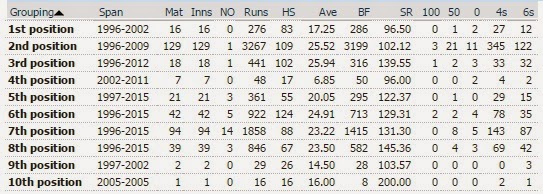
Stats by batting position –
Shahid Afridi - ODI statistics by batting position
Stats by bowling position –
Shahid Afridi - ODI statistics by bowling position
One look at the above stats reveal that he has been all over the place. Was he a pure batsmen? Not really sure since he has played in all positions (baring 11th) in the batting line-up with an average of 23.57. Was he a bowler? Yes, 395 wickets in ODI format is not a fluke. Was he a fielder? Someone who debuted in the 1990’s are usually not known to be as good as the fielders of today, but he wasn’t bad either. So, can we safely claim he’s an all-rounder? Statistically, he definitely is. Is he one of the best all-rounders? Debatable. 

Afridi started his career as a batsman who can bowl leg-breaks. He ended as a bowler who can bat a bit. His initial batting success raised expectations from him (more so being from Asia where Cricket is the biggest religion) and he never stood up to those expectations vis-à-vis batting. But he was always a joker-in-the-pack. You never know when he makes a difference.

Personally, I have been a huge fan of Shahid Afridi. What makes Afridi special for me is the time he made his ODI debut. If we recollect, mid-1990’s was a time when ODI cricket was undergoing a paradigm shift. Some players, including Sanath Jayasuriya (predominantly a bowler who was given the responsibility to bat as an opener) and Shahid Afridi, were changing the way batsmen were batting. Risk taking, attacking the opposition in the first 15 overs during the fielding restriction were emerging as a key weapon to get a heads-up on the opposition. We remember Jayasuriya as the key proponent of that change. Very few remember Afridi for playing a key part. For a neutral fan, there’s never a dull moment when he’s batting. There are only two modes – boom boom or bust! And that’s the only thing that made me sit and watch his batting whenever I got the opportunity.

Only 3 players in ODI cricket have scored more than 8000 runs and taken more than 250 wickets…
Statistics of Top 3 All Rounders in ODI Cricket - Kallis, Jayasuriya and Afridi
… and Afridi is in that list, behind only Kallis and Jayasuriya!

For me, Afridi will remain an enigma. He was always the danger man when he’s at the crease – either to the opposition or sometimes to his own team. His last innings was testament of the latter. Five wickets down for 100-odd runs, Afridi arrived at the crease, Pakistan needed Afridi to apply himself, rotate strike, build a partnership and steady the ship. Afridi, however, played a typical “Afridi-sque” innings of 15-ball 23 and departed, much to the disappointment of Pakistani fans. But hey, that’s the only way he plays!

Shahid Afridi, thank you for entertaining 18 years. Cricketing world will surely miss an unpredictable and enigmatic character like you.

PS: all statistical data queried and taken from statsguru, courtesy espncricinfo,com.

wibiya widget

You might also like

Related Posts Plugin for WordPress, Blogger...